
Podcast Episode 58: June 19, 2026
Watch the Video
Listen Now
One 15-Minute Daily Decluttering Habit can help you clean up home and mind!
What if the reason you feel overwhelmed… isn’t your hormones, your calendar, or your to-do list?
What if it’s your kitchen counter?
Or the drawer you avoid opening. Or the piles you’ve stopped seeing.
Midlife has a way of amplifying everything. The brain rewiring is real. The anxiety is real. And when our external world feels chaotic, our nervous system follows.
Here’s the truth:
Physical clutter becomes mental clutter.
Mental clutter becomes emotional weight.
And emotional weight becomes body stress.
That’s why this conversation matters.
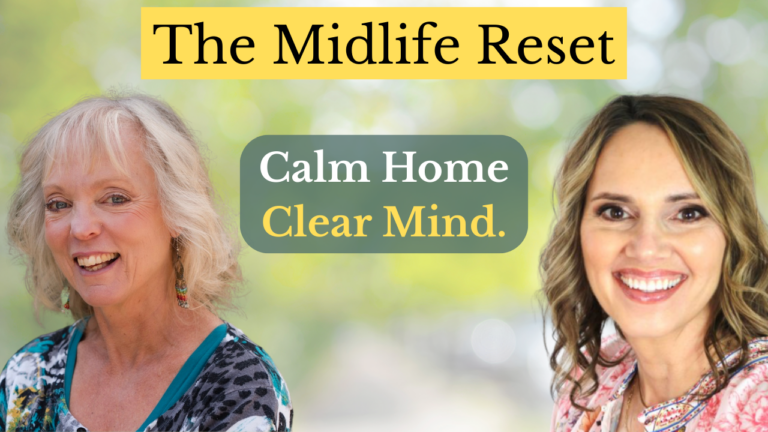
In this episode, I sat down with professional organizer Tracy Hoth to talk about a simple, doable plan:
30 days to a calmer home — using just one 15-minute daily decluttering habit.
This isn’t about perfection. It’s about nervous system hygiene. And in midlife, that’s powerful.
The Shame Behind the Clutter
Tracy has been helping people create peaceful, organized homes since 2008. But her journey into this work began with something deeply human: shame.
She once met a family whose children weren’t allowed to have friends over because of the state of their home. The mother felt embarrassed and stuck. When Tracy offered to help, they worked together room by room — and the transformation was more than physical.
It lifted a weight.
So many women believe they’re the only ones struggling. They think everyone else has it together. Meanwhile, half the world is quietly drowning in paper piles, overstuffed closets, and mental overwhelm.
The isolation fuels stress. And stress fuels everything else.
As I’ve learned through building my SHE Mindfulness program, chronic stress — especially in midlife — isn’t just emotional. It’s biochemical. Elevated cortisol levels affect sleep, weight, mood, and energy.
And here’s what’s fascinating: research shows that clutter can raise stress levels even when we say it doesn’t bother us.
Your nervous system knows.
Small Shifts Create Big Change
One of Tracy’s clients was caregiving for her husband, raising a teenager, and working full-time. Paper had taken over her home. She felt frozen.
Instead of attacking the whole pile, Tracy gave her one small commitment:
Sort five pieces of paper a day.
That’s it.
Five.
The client’s thought shifted from “I’ll never get through this” to “I have a plan.” Over time, she sorted every piece of paper in her home. She created systems. She built confidence. Her entire family felt the difference.
This is exactly what I teach inside the SHE Mindfulness Program.
We don’t overhaul everything overnight. We create small, embodied shifts. Consistency over intensity.
Whether it’s regulating blood sugar, calming the nervous system, or decluttering a countertop — sustainable progress comes from doable daily practice.
The 15-Minute Rule
We tend to believe we need a full weekend — or a massive burst of motivation — to make progress.
But 15 minutes is enough.
You won’t declutter your entire garage in 15 minutes. But you can declutter one shelf. One category. One drawer.
Tracy encourages choosing one focused area for 30 days — clothes, paper, a closet — and breaking it into micro-projects.
You can divide by:
Category (tank tops, pants, shoes)
Or physical area (top shelf, left drawer, shoe cubby)
Then follow her five-step system, which spells the word SPACE:
S – Sort
P – Purge
A – Assign homes
C – Contain
E – Energize
That final step matters most.
Energize: The Step Most People Skip
Energize means maintaining your space by tying it to something you already do.
Every time you put laundry away, you tidy that drawer. Or before bed, you clear one portion of the counter.
One of Tracy’s clients committed to keeping just a small section of her countertop clear. She did 10 minutes before bed every night. Then she added a second section.
Momentum builds energy.
And energy builds identity.
You begin to see yourself differently.
In the SHE Mindfulness Program, I call this self-leadership — stepping out of survival mode and into intentional action. In midlife, we are less tolerant of chaos. That’s not weakness. That’s awareness.
Our nervous systems are more sensitive. Visual clutter becomes constant micro-stress. Creating systems is a form of nervous system care.
You cannot meditate your way out of a chaotic environment. But you can build structures that support a calmer brain.
Organizing as a Practice
I loved something Tracy said: organizing is a practice — just like yoga.
You don’t do yoga once and call it done.
You don’t regulate your nervous system once and never revisit it.
You don’t declutter once and expect life to stop happening.
It’s a rhythm.
And part of that rhythm is celebration. Ideas to celebrate wins include:
post before-and-after photos in community groups.
write down wins in a journal.
do a five-second happy dance.
One couple even keeps a glass jar and adds written “wins” every Friday, then reads them at the end of the year.
In the SHE program, I encourage colourful sticky notes on the fridge — just like we celebrate children’s artwork. We deserve visible reminders of our progress, too.
Celebration wires the brain for repetition.
The Legacy Piece
There’s another layer to this conversation.
At some point, someone will have to go through our things.
One of Tracy’s clients recently lost her father after caregiving for him. She shared something powerful: “Just don’t stop telling people to take care of their stuff before they go.” Grief is heavy enough.
Decluttering isn’t just about aesthetics. It’s about legacy. It’s about lightening the load — for yourself now, and for those you love later. Letting go can be generous.
Decluttering the Mind
Perhaps the most powerful takeaway from our conversation was this:
The same five steps work for your mind.
Sort your thoughts.
Purge what isn’t needed.
Assign homes to tasks.
Contain them in calendars or notebooks.
Energize by reviewing and celebrating.
When you walk into your kitchen and drop items on the counter, ask:
Does this have a home? Or does it not have a home yet?
Same with your thoughts. Do your worries have a place to land? Or are they just piling up in your nervous system?
Decluttering your mind and decluttering your home are deeply connected practices.
That’s why in the SHE Mindfulness program, we address all three layers:
Mind
Body
Environment
Because everything talks to everything else.
Where to Begin
If you’re feeling paralyzed by clutter, start here:
Choose one small area.
Set a 15-minute timer.
Follow the SPACE steps.
Celebrate the win.
Repeat tomorrow.
You don’t need a mountain retreat. You need a timer and a drawer. When you reset your space, you reset your nervous system.
That is midlife magic.
Resources
Tracy offers a free 15-minute Declutter Challenge that walks you through the SPACE steps, plus her Organized Life Academy for deeper, structured support.
And if you’d like to explore how decluttering your environment connects to regulating stress, improving energy, and finding clarity in midlife, I invite you to watch my free masterclass on the SHE Mindfulness program.
Because a calm home supports a calm mind. And a calm mind supports a vibrant body. And you deserve all three.

Get a free preview of the SHE Mindfulness Program. This quick video will offer 3 tips for getting started on your midlife reset. It’s your turn to clean up big time!