
Podcast Episode 53: April 10, 2026
Watch the Video
Listen Now
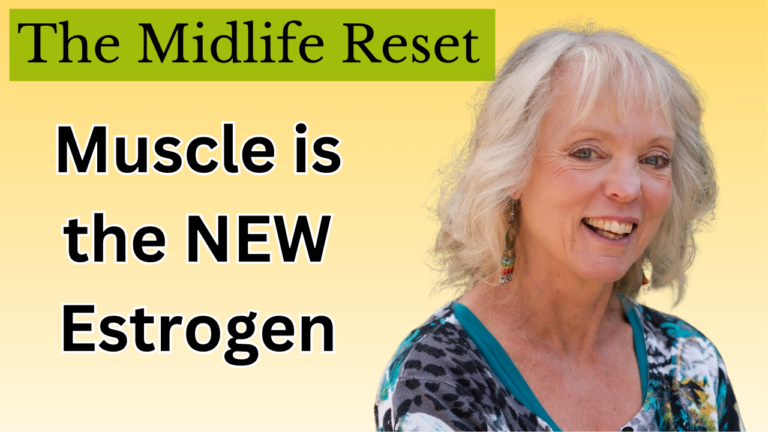
How many times girlfriend have you heard you should lift weights? But what does that really look like? Is it safe for menopausal women?
Today’s episode of the Midlife Reset podcast is all about strength. By the end, you’ll have a solid understanding of where it fits into your fitness plan and 3 guidelines to keep you injury free.
I’ve had to reorganize a lot of my activities to prioritize strength at the age of 62. And I’m helping hundreds of other women figure out how to age strong through my SHE Mindfulness Program.
What Works and What is all Hype
Flash back to the 80’s. We’re old enough to remember the hair, the high cut leotards and “5 more, 4 more, 3 more”. Right? Aerobics was queen. God forbid we bulk up like guys. We wanted to be toned. And cardio burned those calories. Or so we thought.
I remember working at the YMCA, 1984. In my fitness trainer course, the leader actually put a slide up that said “eating fat makes you fat”. I bought it. Didn’t you?
Hindsight, which is of course 20/20, shows all the flaws in that logic. But the old ideas are still very pervasive.
I have a friend, I bet you do too, that is super fit. She runs with the big dogs. If exercise is healthy then she is going to be extra healthy by exercising hours every day. In the old days, I wanted to be her. I wanted to be super fit. It just turned out to be really painful. And if you watch a lot of those long time athletes in their 60’s and 70’s, notice the limping when they get up? The number of pain pills they need to just get going?
In our wiser years, I think we want to age strong. Maintain our independence. Have agency to choose an overseas hiking trip or play on the floor with grandkids. Isn’t it time to let go of those false narratives around exercise?
Here we are in midlife. You may be sticking to your aerobic fitness habits but the belly is getting awfully soft. Darn. It’s so hard to buy nice pants now. Right?
Here’s what no one told us in the 80’s
… or even now. Cardiovascular fitness is important for longevity and quality of life. But it is not a great weight loss strategy in and of itself.
When we were young, we had a lot of estrogen. And it was doing a lot more than regulating our cycles. It was quietly acting like a metabolic bodyguard.
Estrogen helped direct where fat was stored in the body. In our reproductive years, it encouraged fat storage in the hips, thighs, and butt — what we often call the “pear shape.” That pattern isn’t random. It’s biologically protective. Subcutaneous fat in those areas is metabolically safer and less inflammatory than abdominal fat.
But estrogen didn’t just influence fat location. It also helped:
• Improve insulin sensitivity
• Support healthy glucose uptake into muscle
• Reduce visceral (belly) fat accumulation
• Maintain muscle mass
• Regulate appetite and satiety signals in the brain. I literally have leptin insensitivity now. Which means it’s hard to tell when I’ve had enough to eat. That’s why I push Mindful Eating so vigorously. I do have a free guide to get you started. Check the show notes.
Anyway, in simple terms: estrogen made it easier for our bodies to use carbohydrates efficiently instead of storing them.
It also enhanced how muscle cells responded to insulin. And muscle is a major glucose “sink.” The more efficiently muscle absorbs glucose, the less likely it is to be stored as fat.
That’s one reason many women could eat more freely in their 20s and 30s without the same metabolic consequences they experience in midlife.
There’s also a mitochondrial piece.
Estrogen supports mitochondrial function — those little energy factories in your cells. Better mitochondrial function means better fat oxidation. You were literally better at burning fuel.
I was telling all this to a different friend recently and she said, “estrogen does all that?”. And way more we can talk about another day.
We need to talk strength training
Because muscle can take over some of the metabolic work estrogen used to help with. And cardio or aerobics do not make muscle, in fact the opposite can be true. I covered this in detail in episode 19. Really recommend having a listen because those outdated ideas still hold a lot of real estate in my brain. Probably yours too.
For years, I puttered around on those circuits that show up in gyms. You sit in the machines and pump out a few rounds. Done in less than 30! Or I signed up for fusion classes that included throwing around a few free weights. We all did the same moves at the same pace for the same time. It was sweaty. But did it really build strength?
Here’s what I’ve learned.
From friends like Lynn Sederlof-Aristo of Be Fit after 40. And PJ Wren from Fitness with PJ, I will link to their podcast episodes in the show notes so you can hear this from the experts directly.
Strength training in midlife is not about becoming a bodybuilder. It’s about replacing some of the metabolic support estrogen used to provide and keeping your body resilient, strong, and independent. And it does not need to be extreme to be effective.
I have shaved 5% body fat off after the age of 60. I’ve kept my weight lower than it was in high school. I feel confident slinging my kayak around by myself. And it’s not rocket science.
It truly is mainly a mindset shift. We were soooo steeped in dance fit, running, cycling, getting our heart rate up. We just didn’t get the exposure to strength training.
And fitness programs, gyms and influences on the socials push these one size fits all programming. It just gets more and more confusing.
So let’s break it down.
1️⃣ Lift Something Heavy (For You) — 2–3x Per Week
Focus on full-body sessions that hit major movement patterns:
Squat
Hinge (like a dead lift)
Push (like a chest press or pushup)
Pull (like a lat pull down or cable machine)
Carry (hauling a weight in each hand and walk across the room)
This can be done with dumbbells at home, resistance bands, or gym machines. The key is that the last 1–2 reps of a set feel challenging, without causing pain.
Here’s how I do it. I pick a weight that I’m confident about. I do 10 reps of the exercise. How hard was that? Did I finish and say, whatever. Or did I get to #8 and was shaking. You may have to play with a couple different weights at first. Once you find the weight that left you shaky at #8. Go down a pound or two. Or for lower body stuff, go down 5 pounds.
Now do a second set. Can you get to 10 feeling pretty tired but not like you’re going to drop dead? That’s your weight for the first 6 weeks.
Aim to do 2 sets of each of the five types of exercises at this weight. Before upping the weight, add a 3rd set to each exercise. Increase weights in small increments. Muscles adapt faster than tendons so to prevent injury, take this cautious approach.
Keep a log of what weights you’re using. I use the notes app on my phone.
2️⃣ Short Sessions Work — 20–30 Minutes Is Enough
Most of those fitness classes are one hour so we got the idea that we needed to exercise that long. And a 5k walk is about that too. But consistency beats duration.
Follow the simple formula we’ve already laid out:
5 movements representing the major muscle groups and how they function
2–3 sets each
8–12 repetitions
Done in 25–30 minutes, 2–3 times per week. Short, focused sessions protect your muscle, improve metabolism, and support your overall health — without taking over your life. Imagine what you are going to do with the literally HOURS left over that you used to spend on the treadmill. Reading a juicy novel? Dinner with friends? Starting the SHE Mindfulness program? You’d have time for thinking about your life plan wouldn’t you?
3️⃣ Focus on Progress, Not Variety
Strength training can feel repetitive. But repetition is how muscles adapt. I like to listen to podcasts to keep it fresh. My friend actually listens to yoga chanting music and makes this a meditation in motion thing. In the past, I’ve enjoyed like really raunchy heavy metal from the 1990’s. Find your groove and it makes the session much more fun.
Instead of constantly switching workouts, generate challenge by adjusting the weights every six weeks. You can also progress from 10 to 12 reps. And then there’s pacing. The movements done really slowly builds muscle one way and adding some more explosive aspects builds different ways.
If you are going to a gym, I hope you make friends. That motivates me. But if you’re working out at home, find a buddy that you can text how great you feel post workout. We have accountability partners in the SHE Mindfulness program and it keeps you going for sure.
Tracking progress is also motivating. Seeing yourself get stronger is deeply satisfying — especially in midlife, when so many other things feel out of your control. I’m pretty proud of myself for what I’m lifting now. Kinda bad ass.
Is it Safe?
You might be thinking “I’m afraid of getting hurt.” Valid. Many midlife women have old injuries, joint sensitivities, or bone concerns. But properly loaded strength training improves bone density, joint stability, balance, and pelvic floor function. Start with guidance if needed — even a few sessions with a trainer or physiotherapist can build confidence.
I got several injuries from yoga. Ooops. And from pushing too hard when my body was exhausted in classes and group rides. But I have to say… since I’ve taken this seriously and got the expert guidance, nothing. In fact, old injuries are less a concern now.
It all seems so confusing.
A few months ago, a friend messaged me. I joined this really amazing gym because I know I have to lift weights but omg I have no idea what to do. Can you help? You know it! Let’s have fun, I said.
We have not had much exposure to the whole bro gym thing. It feels so masculine and overwhelming. But you know, I go to my local university to work out. Alma mater, I get a discount. And these young girls today…. They rock. I can’t believe what some of them are pushing. It opened my eyes.
But it’s totally normal to feel intimidated. Getting a personal trainer can help but I know it’s expensive. Most facilities do have general staff that can explain the use of a machine when you ask. I’ve made a goal to try something new each week. Today it was wrist straps to support my hands so I could up my weight on deadlifts. Anyway.…
Most people are focused on themselves really. And I’ve found most people are pretty enthusiastic about sharing what they know. The young students at the university could be my grandchildren but they’re quite sweet.
Walking in that first time, with the crazy music and those smells and some bro swearing as he drops the barbell. Yeah. It’s a lot. But you’re on a mission. Get strong! One benefit of getting to midlife… we don’t have a lot of time to waste. We are so over impressing someone else or making them happy. It’s our turn, right?
But what if you’re really busy?
And if you think you don’t have time, heavens girlfriend… have you been listening??? This is about priority, not hours. Strength training is one of the highest ROI health habits you can do. It reduces visceral fat, improves insulin sensitivity, supports mood, cognition, and bone health — and protects your independence.
In your 30s, exercise may have been about burning calories. In your 50s and 60s, strength training is about sending signals to your body:
“Keep this muscle.”
“Stay metabolically active.”
“Protect my bones.”
“Stabilize my joints.”
That signal changes everything. Consistent, safe, progressive strength work is your midlife superpower.
Get A Whole Program
And if you are interested in just getting everything going in an exciting direction… weight loss, better sleep, feeling kick ass strong… then we should talk! The SHE mindfulness program contains wisdom about all aspects of midlife growth. And you’ll have a supportive community of women just like us to work alongside. A new cohort is starting soon so it’s a great time to join.
Thanks for tuning in and please share this with as many women as you can. We need to get the word out there my friends.
Ready to dive deeper? The SHE Mindfulness program offers a comprehensive, step by step solution to finding motivation, boosting energy and taking back your life again.