
Podcast Episode 61: July 31, 2026
Watch the Video
Listen Now
So what’s going on for you? Night sweats? Hot flashes? Tossing and turning at night? Belly weight from nowhere? How about the anxiety???
You might feel as though your body is in full blown crisis mode. Digestive issues crop up. Joints go out of whack. Life just feels… well, really hard now.
This is the biggest hormonal upheaval since puberty. And, girlfriend, there is so much misinformation and manipulation out there. We go to our doctor, thinking that’s where we’ll get the real truth, and leave feeling more confused than ever.
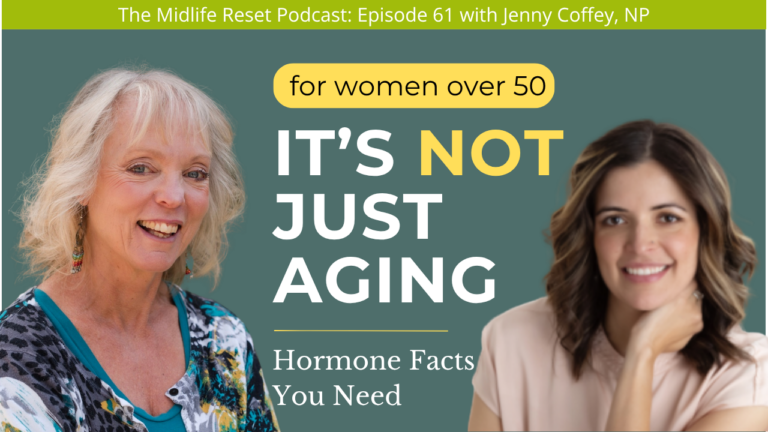
Today, my guest is a Nurse Practitioner who got fed up with seeing old, sick and frail women in hospital and doctors’ clinics. She KNEW that if she could get to them earlier, give them supportive hormone treatments to help bring balance back to their systems… their lives would be transformed.
In this post, we’re going to highlight three essential hormones, what their role is in your body and how to boost them in perimenopause and menopause. Our information will give you clarity on what the buzz is all about.
So many women going through perimenopause or menopause do the right thing: they go to their doctor. They describe the night sweats, the hot flashes, the weight gain, the sleeplessness. And too often, they leave with a prescription for antidepressants or sleeping pills — but without answers, and without feeling seen as a whole person.
That gap in care is exactly what nurse practitioner Jenny Coffey set out to fill.
—
A Healthcare System That’s Failing Everyone
Jenny’s path to hormone health wasn’t a straight line. She completed her undergraduate degree at McMaster University (Hamilton, Ontario) to become a registered nurse, spent nine years working in hospitals, then went back to Western University (London, ON) for a graduate degree to become a nurse practitioner — someone who can diagnose, prescribe, and order labs, functioning very similarly to a family doctor.
Her goal was to help people earlier, before they arrived at the hospital with fractures, diabetes, and UTIs.
What she found instead was a system built to manage disease, not prevent it. In all her years of training, she doesn’t remember a single class on menopause, hormones, or even how to keep people healthy.
And it wasn’t just her. Primary care, she’ll tell you, is a tornado. Fifteen to twenty minutes per patient. Piles of prescription refills. Stacks of forms. There’s simply no time to sit with someone and explain the *why* behind their symptoms, let alone explore alternatives to medication.
The system, she’s quick to point out, isn’t just failing patients — it’s failing healthcare providers too.
—
The Turning Point
Jenny eventually opened a practice with her sister Camilla, initially focused on medical aesthetics. But they kept hearing the same refrain from clients: *sure, I’ll take the Botox, but what about these night sweats?*
For a while, Jenny didn’t know what to tell them. She had almost no training in it. But the pattern was impossible to ignore.
She started slowly, taking a course here and there, before completing advanced training under physician Dr. Neil Rousier. It changed everything.
“Every time I attended a lecture, my head would just pop off. Wait — what? We can prevent *that*? Why isn’t everybody doing this?”
She came home from each training weekend more fired up than the last. Things, she decided, had to change.
—
What Women Are Actually Missing: The Hormone Conversation
When women arrive at Jenny’s clinic, they’ve usually tried everything else. Many believe they’re choosing between hormones and breast cancer risk — and some are so desperate they say they don’t even care anymore.
The first thing Jenny does is untangle that fear.
When we talk about menopause and perimenopause, the hormones in question are the ones made in the ovaries: **estradiol, progesterone, and testosterone**. Much of the fear around hormone therapy stems from studies using *synthetic* versions — the kind found in some birth control pills and older hormone therapies — which behave differently in the body. Bioidentical hormones, by contrast, are structured the same way as what your ovaries used to produce. Your body simply knows what to do with them.
And almost all women, Jenny says, are candidates — even those with a personal or family history of breast cancer.
—
Progesterone: More Than Just a Sleep Hormone
Progesterone has remarkable effects on the central nervous system. Jenny has helped women come off Ativan and sleeping pills by simply getting their progesterone to a therapeutic level. The results speak for themselves: better sleep, fewer night sweats, improved mood, no more heart palpitations, no more 3 a.m. racing thoughts.
Beyond that, progesterone has been studied for its protective effects against breast, ovarian, and uterine cancers. It reduces inflammation. It helps regulate mood and anxiety in ways that antidepressants simply don’t address at the root.
One of the most common frustrations Jenny encounters: women who’ve been told “hormones didn’t work for me.” More often than not, it was a dosing issue, not a hormone issue. Some women need very little; others need quite a bit. Getting that calibration right takes time, attention, and the right questions — none of which the current system is set up to provide.
—
Estradiol: Protecting Your Future Self
Estradiol is a specific form of estrogen — estrogen being a broad umbrella term, the way “vacation” covers everything from road trips to cruises. Estradiol is the form your ovaries used to make, and it’s what the clinic uses.
Most women wait out their hot flashes thinking that once they pass, they’re done. But that’s actually the moment to pay closest attention. Once the ovaries shut down entirely, bone density begins to break down rapidly. The brain changes. The skin changes faster. And the risks that quietly accumulate — hip fractures, heart attacks, strokes, dementia, serious urinary tract infections — become much more real.
Estradiol is protective against all of these. That’s not a small thing.
—
Testosterone: Not Just for Men
Hormones, as Jenny puts it, are for humans — not for genders. Women produce testosterone too, and its absence is felt everywhere.
Testosterone supports muscle mass, energy, mood, and libido — both physically and mentally. It improves the pelvic floor. It maintains the health of vaginal tissue, the bladder, and the urethra, which is part of why UTIs become so common in older women.
One of the most quietly devastating symptoms of menopause is what’s known as genitourinary syndrome of menopause (GSM) — where the anatomy of the vulva and vagina actually changes, tissues thin and shrink, and sex becomes painful or impossible. Many women are told to just relax, or drink more wine. Most eventually stop having sex altogether.
The answer isn’t lubricant. It’s restoring the hormones that kept those tissues healthy in the first place. Lubricant has its place, but it can’t rebuild what hormones built.
—
Thyroid: The Missing Piece
One more thing that often gets overlooked: thyroid function. Changes in the thyroid frequently accompany perimenopause and menopause, but because doctors are trained to look for *disease*, a thyroid that’s simply becoming less efficient often goes unnoticed and untreated.
A sluggish thyroid affects metabolism, energy, joint pain, hair, and body composition — all things women are often told are just part of getting older. They don’t have to be.
—
A Different Kind of Care
At Jenny’s clinic, Font Health, new patients go through a 16-week program — because that’s roughly how long it takes to get hormones dialed in, address the misinformation people have absorbed, interpret labs in context, and truly move the needle. After that, many choose to stay on a maintenance plan, because their family doctors often don’t know what to do with a carefully individualized hormone protocol.
The results are striking: body fat reduction (particularly visceral fat), significant improvement in joint pain, reversal of diabetes, people coming off antidepressants and sleeping pills, and a general reclamation of energy and quality of life.
But the vision is longer than that. The goal isn’t just to get rid of hot flashes. It’s to protect bone density, keep blood sugar stable, support brain health, and prevent the cascade of conditions that quietly accumulate when hormones are left to decline unchecked.
—
Access Jenny’s clinic to learn more: https://fonthealth.ca/contact/
What to do with your new found energy? Once you start sleeping better and have a greater endocrine balance, I have a great program to help you assemble a life filled with passion, purpose and peace. It’s called the SHE Mindfulness program. Hundreds of women just like you have lost weight with mindful eating… stopped people pleasing with mindful self care… and gained strength & confidence with mindful movement.

Practitioners, like Jenny, are finally getting us women the research backed facts we need to address hormonal upheavals. Now you’re ready to reshape your midlife.
The SHE Mindfulness program is a holistic, step by step program supporting you as you reset.