
Podcast Episode 64: September 10, 2026
Watch the Video
Listen Now
You’re stretching every morning. You’re doing your workouts. You’re doing everything “right.” So why do you still wake up feeling like you slept on a plank of wood?
Here’s the thing — I hear this from women in our community every single week. It’s not you. There’s an actual name for what’s happening in your body right now, and it has nothing to do with how hard you’re trying.
Today I’m going to explain exactly why your body feels stiffer than ever — even while you’re doing everything you were taught to do — and give you three simple rules that will change how you move, starting this week. Stick with me til the end of this episode and I’ll have a free resource for you to support pain free movement.
So let’s dive in.
And today’s topic is one I get asked about *constantly*. It’s this feeling of — “I’m doing the stretches. I’m doing the workouts. So why do I still feel like the Tin Man before his oil can?”
This stiffness you’re feeling? It’s real. It’s not in your head, and it’s not because you’re “not trying hard enough.
There’s actually a term for it that’s gaining more attention in research and in clinical circles — it’s called **Musculoskeletal Syndrome of Menopause**. And once you understand what’s going on underneath the surface, this whole stiffness thing starts to make a lot more sense.
Here’s the short version. As estrogen declines during perimenopause and menopause, it affects way more than your hot flashes and your mood. Estrogen actually plays a role in keeping your connective tissue — your tendons, your ligaments, your fascia — hydrated and elastic. It also plays a role in how your joints stay lubricated, and how quickly your muscles recover after you use them.
You know how your skin is looser? Wrinklier? Drier? The inner layers of skin are part of that fascia. So what you see on the outside is happening inside too.
When estrogen drops, several things can happen at once:
– Your joints can feel drier, stiffer, achier — even first thing in the morning before you’ve done anything at all
– Your muscles may take longer to recover after exercise than they used to
– Your fascia — that connective webbing that wraps around every muscle, bone and organ in your body — can lose some of its natural glide and elasticity
– And you may notice new aches in places that never used to bother you — hips, shoulders, hands
This is why so many women tell me, “I’m doing the same workouts I’ve always done, and somehow I feel *worse*, not better.” It’s not that you’re doing something wrong. It’s that your body’s underlying chemistry has changed, and the old rules don’t automatically apply anymore.
I want to be really clear about something here: this isn’t about scaring you, and it’s definitely not about telling you there’s nothing you can do. It’s actually the opposite — once you understand *why* this is happening, you can work *with* your body instead of constantly feeling confused by it.
Now, I want to gently encourage you on something, and I say this as someone who cares about you actually feeling better, not just feeling informed.
If you haven’t already, this might be a really good moment to have a conversation with your doctor about hormone therapy.
I know — for a lot of us, that phrase used to carry some baggage. Maybe you heard scary things about hormone therapy years ago, or maybe your mother’s generation was told to avoid it altogether. But the research and the medical guidance around this has evolved a lot, and for many women, it’s worth an honest, individualized conversation with a doctor who’s up to date on the current research — ideally someone who specializes in menopause care.
I’ve had some great conversations with experts like gynaecologists and nurse practitioners and naturopaths here on the podcast and I’ll put some episodes to link to in the show notes. It might be worth a listen before you go to your doctor.
I’m not a doctor, and I’m never going to tell you what’s right for your specific body and your specific health history. But what I *will* tell you is this: you deserve to walk into that appointment informed, and you deserve a provider who takes your symptoms seriously instead of brushing them off as “just part of getting older.”
So if stiffness, joint pain, or these musculoskeletal changes are something you’re dealing with — bring it up. Ask specifically about how hormone therapy might relate to joint and connective tissue health. You are allowed to advocate for yourself in that room.
Okay, so now let’s talk about what you can actually *do* — starting today — to work with your body instead of against it. I’ve got three rules for you. Write these down if you need to.
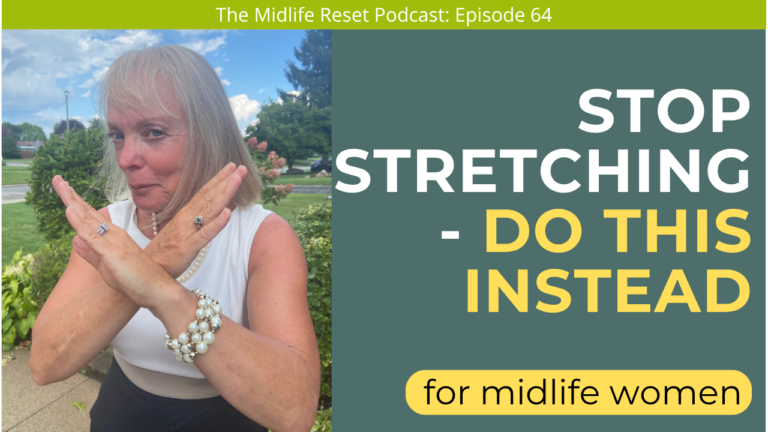
Rule #1: Don’t Stretch
What kind of craziness is this??? I teach yoga, right? I know this sounds backwards. Your body feels tight, so your instinct is to stretch it more, right? Pull a little harder, hold a little longer?
Here’s the problem. When your fascia has already lost some of its natural elasticity, aggressive or forceful stretching can actually create more stress on that tissue — not less. Instead of gently encouraging the tissue to lengthen, you can end up creating micro-stress, which your body then responds to with more tightness, almost like a protective clench.
So here’s the shift: gentle, sustained movement — not forceful stretching. Think slow, breath-led movement that invites your fascia to soften, rather than yanking on it and hoping it gives.
In practice, this means less grabbing a toe in a pose or pulling with a strap. It means stopping the movement before you feel a big sensation. It means smaller, slower, more boring movements. What you are doing is creating a sense of sensitivity and safety for your body. Not overriding its signals. This has a longer term effect of easing discomfort.
It’s like if every time you rounded a corner, you stubbed a toe. After a few times, your body would begin to brace for impact. Your jaw might tighten, Your digestive system might brace. A headache might pop up. If you walked more mindfully, and didn’t stub your toe for a few days, those symptoms would abate. Sensation is your body’s love language.
This is actually one of the core principles we build into every session inside the SHE Mindfulness program — movement that respects where your body actually is today, not where it used to be ten years ago.
Rule #2: Allow Adequate Rest Days Between Workouts
This one trips up a lot of high-achieving women, because so many of us were raised on the “no days off” mentality. But remember what we just talked about — your recovery time isn’t what it used to be, because of those hormonal shifts.
If you’re doing strength training or more vigorous movement back-to-back with no rest, you may actually be working against your own progress. Your muscles and connective tissue need that recovery window to actually rebuild and adapt. Skipping rest days doesn’t make you tougher right now — it can just leave you more inflamed, more stiff, and more exhausted.
So build in real rest. Not guilt-laden rest. Real, intentional recovery.
I know this is so hard for me. It’s like a badge of honour to say I hit the gym today or rode my bike to work. I don’t want to admit to how many injuries it’s taken to teach me this hard lesson.
How does this look for your weekly fitness plan? Strength training twice a week lower body and twice a week upper body. You can combine these into one workout, if you have the time. Which means gym 2x weekly. Or working a muscle group 2x weekly. That allows 3 days recovery. You need that much, girlfriend. To really build the muscle.
For cardio, it means 3 bike rides a week maximum. Or 3 runs a week. Get the picture?
I love to move and I can’t just sit still all week. So fill in the recovery days with very gentle yoga (remember rhythmic, breath centred movement), slow walks in nature, easy swimming, tai chi, etc. So many of the SHE clients have seen scales move and bodies lose their fluffy aspect by incorporating more rest time. This is reflective of what midlife womens’ bodies need.
Rule #3: Balance Slow Strength Training With Vigorous Movement in Mini Doses
This is where a lot of women get stuck in an all-or-nothing pattern — either they’re doing slow, gentle stretching every day and nothing else, or they’re going hard with high-intensity workouts and wondering why their body is rebelling.
The sweet spot is a balance: consistent, slow strength training to protect your bone density and muscle mass — that’s non-negotiable as we age — *combined* with short, vigorous bursts of movement in small doses. Think 5 to 10 minutes of something that gets your heart rate up, rather than an hour-long, high-intensity session that leaves you flattened for two days.
This combination — slow and steady strength, paired with small doses of vigour — tends to work *with* a menopausal body instead of depleting it.
What I love about this rule is that it is so time saving. Remember we always thought 60 or 90 minute CrossFit classes were the ticket to getting in shape? Forgetaboutit. On your exercise days (remember there are multiple rest days per week), add in a little jumping, skipping, plank walks, push ups or some similar movement.
I can feel you cringing when I say this. What about my knees? What if I break something???? I know. This is the thing as we get older. The fear of movement starts to control our lives. The goal is about 10 minutes but what if you tried a little sprint just til the stop sign ahead. Build up the tolerance in your joint to handle the impact of sudden movement. We run into problems when we try to sustain that joint jolting for more than a few minutes. But a little wake up call? That builds tissue, muscle, proprioception and confidence.
Of course, if the movement causes sharp pain in the joint- abandon ship. Let’s find an alternative. But I think you may be pleasantly surprised that us old girls can still run, jump and play when we go about it carefully.
The Takeaway
If you’re feeling stiffer than you used to, even while doing “everything right” — please hear me when I say, it’s not a personal failure. Your body is going through a real, physiological shift, and it deserves a new approach, not more punishment.
Have that conversation with your doctor about hormone therapy. And start applying these three rules — gentle movement over aggressive stretching, real rest days, and a balance of slow strength with small bursts of vigorous movement.
Looking for a little more guidance on how to implement this in real life? I have a couple suggestions.
First, there is a free online course called “The Miracle Cure for Sore Joints”. There are 4 versions of a simple, five minute stretching routine (including one in bed and one in a chair) that I myself use every day. My clients love the simplicity of this. Gets them “juiced” up for whatever activity comes that day. There is a link to get the program free in the show notes.
We go deeper into this topic within the SHE Mindfulness program. It’s where these principles come to life in real, guided sessions, so you’re not left guessing about how to apply any of this on your own.
Until next time — be gentle with your body. It’s not working against you. It’s just asking you to listen a little differently.
If you found this podcast interesting, please consider sharing with a friend. Let’s help more women discover this common sense approach to their health.

Ditch the aggressive stretching and gently awaken the joints with these simple video lessons.
All this, and more, is covered in the SHE Mindfulness program.