
Podcast Episode 67: October 23, 2026
Watch the Video
Listen Now
Lost your job. Watched your kids move out. Ended a relationship. Hit perimenopause. None of these come with a funeral — but your nervous system doesn’t know the difference.
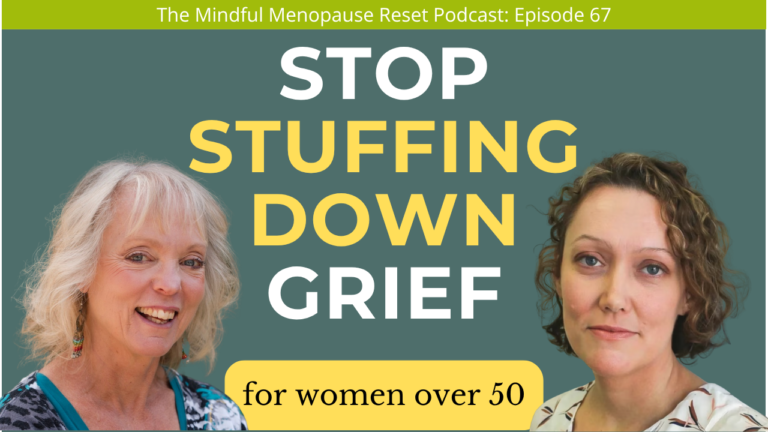
This is a conversation with Dr. Aoife Earls, a naturopathic doctor in St. Catharines, Ontario who specializes in helping women navigate the kind of grief nobody sends a casserole for.
We’re talking about ambiguous grief, disenfranchised grief, and why so many midlife women feel like they’re “losing it” when really, their body is just trying to process an enormous amount of change at once.
The Physical Toll of Loss
Keep reading to find out what is actually happening physiologically when loss piles up — the adrenaline spikes, the sleep disruption, the digestive chaos — and why rest isn’t a luxury during this time, it’s biology. We also get into why guilt shows up the moment joy tries to return, and a simple tool (the “sidecar”) for carrying that guilt instead of fighting it.
Grief Isn’t Just for Funerals
Most of us have felt but never had language for this kind of grief. By midlife, most women are carrying a long list of losses that never got a formal goodbye — a pet, a job, the family home, even the shift in identity that comes when your kids move out and your role as “mom” changes shape. This ambiguous or disenfranchised grief is real loss. But people around you (and sometimes you yourself) don’t fully recognize as grief at all.
Are you finding this article helpful? Please share it with someone who needs to hear this too.
Why It Catches up with Us in Midlife
Between roughly ages 45 and 70, women are often navigating several of these transitions at once — retirement or job loss, kids leaving home, divorce or separation, a health surprise, and the physical upheaval of perimenopause or menopause, all layered on top of each other. The nervous system doesn’t distinguish between a “big” loss and a “small” one; it just registers change, and it responds with the same physiological toolkit regardless: adrenaline spikes, disrupted sleep, digestive issues, a dampened immune response.
The brain craves a predictable story, and when that story suddenly changes, it treats the disruption as a threat that needs managing.
Rest is Mandatory – Real Rest
Rest matters so much more than our culture tends to allow for. Grief recovery is like healing from a concussion: the brain needs real downtime to do the work of rebuilding its sense of self and story, and skipping that stage doesn’t make the work go away, it just gets postponed, often resurfacing later as burnout or a feeling of “why can’t I just push through this anymore?” This is so hard to actually practice —
the guilt of resting when you have responsibilities,
the cultural expectation that women bounce back quickly, and
on paper, you have a full and happy life.
I was blindsided by “empty nest syndrome”. The sense of loss was embarrassing as I never considered myself wrapped up in my kids’ lives. I thought I had a career, social life, travel…. I cried every day for a year when the first one moved out. I just couldn’t adjust to not hearing his car in the driveway or key in the lock. I was gutted. But who would send a casserole for that???
Welcoming Back Joy and Curiosity
It starts with “glimmers” — small, almost throwaway moments of noticing something good – like a nice sunrise or a pair of pants that feel good against your skin — as a way of gently signalling to your nervous system that not everything is unsafe. This is the biochemistry of connection and creativity. Oxytocin and vasopressin, released when we’re engaged in something relational or creative, work in direct opposition to adrenaline, which is part of why returning to something as simple as a dance class or singing in the car can genuinely support recovery.
Remember the old fashioned shows that had the character riding in a motorcycle with a “sidecar”? That’s like our guilt and shame. Instead of trying to eliminate the guilty voice that shows up when joy starts to return (the fear that feeling better means forgetting someone, or that you don’t deserve to feel okay again), let that part of you ride along rather than demanding it disappear before you can move forward.
David Kessler’s book that he co-authored with Elizabeth Kubler-Ross, “On Grief and Grieving”, offers the “three C’s” — you didn’t cause it, you can’t cure it, you can’t control it. This is a way of interrupting the self-blame loop so many women fall into after a job loss, a divorce, or a diagnosis.
How a Naturopath Can Help
Beyond supplements or a diet plan, a doctor like Aoife can help at
rebuilding a predictable rhythm around sleep and nourishment,
supporting the nervous system directly through herbal medicine and targeted nutrients,
encouraging rhythmic movement (not exercise for its own sake, but movement that helps the body metabolize adrenaline), and
gently rebuilding a sense of safe connection, often starting with very small steps.
Now is not the time to overhaul your diet in the middle of an acute loss, like losing a spouse or closing out an estate. That’s often not the moment for a big physical change. Sometimes the kinder, more effective move is to add one small supportive thing rather than restrict or overhaul anything at all.
When to Ask for Help
Almost every woman going through midlife has been “kicked in the knockers” by loss more than once, and asking for help with that, even when you’re the one who usually holds everything together for everyone else, is its own kind of self-compassion practice.
It’s time to ask for help if you are having trouble getting daily tasks done or have been hiding at home for more than three months. This is not carved in stone but general guidelines.
How I Can Help
Understanding that the brain requires rest when processing change gives you the permission to slow down and bring mindfulness into your healing.
That’s where the SHE Mindfulness Program can help. This step by step, guided system blends what you already know from yoga and meditation into a gentle reset for midlife women. The program accounts for the overwhelm that midlife women are tackling. It’s not about deprivation or iron willpower but working with your nervous system compassionately and patiently. There’s a free webinar to try the method and see the effectiveness for yourself.
Final Takeaway
You are not falling apart, and you didn’t cause this. You’re allowed to rest.
About my guest: Dr. Aoife Earls is a naturopathic doctor practicing in St. Catharines, Ontario, specializing in supporting women through loss, transition, and the physical toll grief takes on the body.
If you’re navigating a season of change and want more support with the nervous system side of midlife, check out my SHE Mindfulness Program: https://cherylgordonyt.com/she-mindfulness/

This masterclass outlines 3 basic steps that can help you move forward. This is the same approach that we use in the SHE Mindfulness Program.